
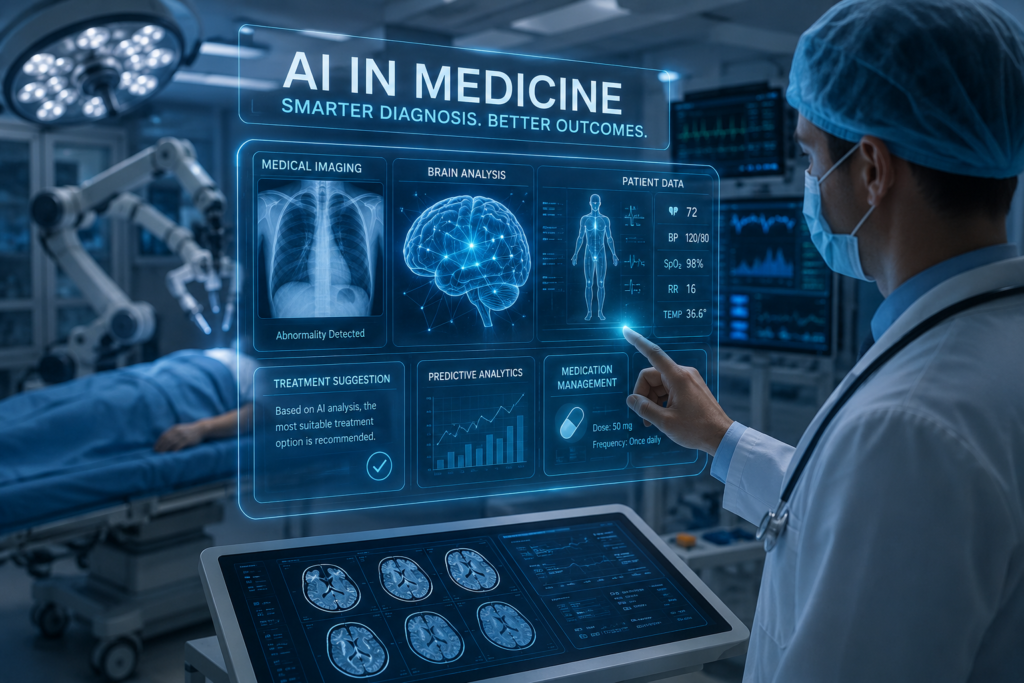
AI in Medicine — The Pulse
The Pulse
Health & Technology
Feature
The Algorithm Will See You Now
June 2026 12 min read Medicine · Artificial Intelligence
Artificial intelligence is not coming to medicine — it has already arrived. In radiology suites, pathology labs, emergency triage desks, and drug-discovery pipelines, machine learning models are quietly reshaping how disease is found, named, and fought.
Diagnosis
Seeing What the Human Eye Misses
The most immediate impact of AI in medicine has come in imaging. Deep learning models trained on millions of scans can now detect early-stage lung nodules, diabetic retinopathy, and skin cancers with accuracy that matches — and in specific contexts surpasses — experienced clinicians. The key isn’t that the algorithm is smarter; it’s that it is tireless and consistent.
Google’s DeepMind demonstrated that its AI could identify over 50 eye diseases from retinal scans with diagnostic accuracy comparable to world-leading ophthalmologists. Separately, studies have shown AI tools catching micro-calcifications in mammograms that radiologists routinely miss under the fatigue of high-volume reading sessions.
The practical stakes are enormous. Screening programs that once required specialists concentrated in wealthy urban centres can now be extended to rural clinics and low-income countries through smartphones and cloud-based models — turning a scarcity problem into a logistics one.
94%
accuracy of AI-assisted skin cancer detection in peer-reviewed trials
40%
reduction in time to diagnosis when AI triage assists emergency departments
$50B+
estimated AI health market size by 2030, up from under $7B in 2021
Drug Discovery
Compressing Decades Into Months
Drug development is a brutal undertaking: a typical molecule takes 10–15 years and over a billion dollars to move from discovery to pharmacy shelf, with a failure rate above 90%. AI is attacking this problem at every stage — generating candidate molecules, predicting protein folding, modelling toxicity, and identifying patient populations for trials.
The watershed moment came in 2020, when DeepMind’s AlphaFold solved the protein-folding problem that had stumped structural biologists for 50 years. Knowing a protein’s three-dimensional shape from its amino acid sequence instantly makes it possible to design drugs that bind it with precision — a process that previously required years of laboratory crystallography.
Startups like Insilico Medicine and Recursion Pharmaceuticals have since used generative AI to design novel drug candidates and advance them into clinical trials in under 30 months — timelines that would have been considered impossible a decade ago.
We are not replacing the physician. We are giving her a second pair of eyes that never gets tired, never forgets a case, and has read every paper ever published.— Perspective shared by AI researchers across the field
Patient Care
Personalised Medicine at Scale
Beyond finding disease and inventing drugs, AI is transforming how care is delivered moment to moment. Predictive models embedded in electronic health records now alert ward nurses hours before a patient deteriorates into sepsis. Natural language processing tools draft clinical notes from spoken consultations, freeing physicians to look at patients rather than screens.
Genomic AI is making personalised oncology routine: algorithms that cross-reference a tumour’s genetic mutations against databases of known treatments can recommend therapies tailored to a patient’s specific cancer variant rather than its anatomical location. A lung cancer is no longer just a lung cancer — it is an EGFR-mutated adenocarcinoma with a first-line match in the model’s suggestion queue.
Mental health is an emerging frontier. Large language models are being deployed as the first point of contact for mental health triage, reducing wait-times in overwhelmed systems and offering immediate support where none was previously available — though this application remains among the most ethically sensitive.
Considerations
Challenges
The Risks That Must Be Reckoned With
The progress is real, but so are the hazards. Enthusiasm for AI in medicine has sometimes outrun the rigour the field demands.
- Bias in training data. Models trained predominantly on images or records from one demographic often perform significantly worse on others. An AI that detects melanoma accurately on fair skin may miss it on darker tones — a failure with lethal consequences.
- Black-box opacity. Many high-performing models cannot explain their reasoning in terms a clinician can interrogate. When an algorithm flags a scan, the physician needs to understand why — not just accept a probability score.
- Regulatory lag. Approval frameworks designed for pharmaceutical drugs and static medical devices struggle to accommodate software that updates continuously and behaves differently across hospital settings.
- Data privacy. Training powerful models requires vast patient datasets. Assembling them without violating privacy, eroding consent, or centralising power in the hands of a few technology companies is an unresolved tension.
- Over-reliance and deskilling. If physicians defer habitually to AI recommendations, clinical judgment atrophies. When the model fails — as all models eventually do — the safety net of human expertise may no longer exist.
Medicine has always been the discipline that confronts human fragility most directly. AI does not change that confrontation — it changes what tools are available to navigate it. Used thoughtfully, with rigorous validation and a clear-eyed view of its limits, artificial intelligence may prove to be among the most consequential instruments medicine has ever had. The algorithm will see you now. The question is whether we have prepared it well enough for the encounter.
© 2026 The Pulse — Health & Technology Writing